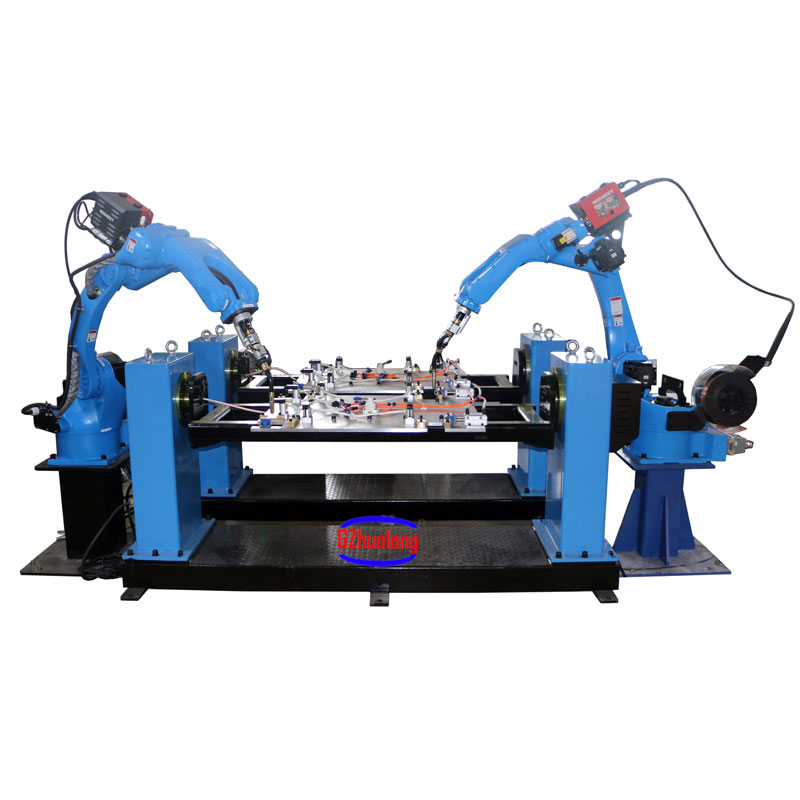
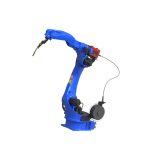
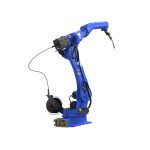

Welding robots are mainly composed of two parts: robots and welding equipment.
Contact usWelding robots are mainly composed of two parts: robots and welding equipment. The robot is composed of a robot body and a control cabinet (hardware and software). Welding equipment, such as arc and spot welding, consists of a welding power source (including control system), wire feeder (arc welding), welding torch (pliers) and other parts.
Arc welding robots mainly use gas shielded welding methods (MAG, MIG, TIG), and for arc welding, conventional thyristor, inverter, pulse or non-pulse power supplies with adjustable waveform can be installed on the robot.
The wire feeder can be mounted on or outside the robot's arm. The hose between the welding torch and the wire feeder is shortened, which helps maintain the stability of the wire feed.
Welding robots are basically seam joining robots, most of which have 6 axes.
With the development of electronic technology, computer technology, CNC and robotics, automatic welding robots, since they began to be used in manufacturing in the 1960s, their technology has become more and more advanced, mainly due to the following advantages:
1.Stabilize and improve the welding quality, and reflect the welding quality in the form of values.
2.Increasing labor productivity.
3.Increase the labor intensity of workers and allow them to work in hazardous conditions.
4. Reduces the requirements for employee work technology.
5. The preparation cycle for product modification and replacement, as well as the corresponding investment in equipment, has been shortened.
Therefore, it is widely used in all walks of life.
Main parameters:
| Vertical multi-joint robot | |||||||
| model | RH14-10-W | RH-18-20-W | RH-20-10-W | ||||
| Input voltage | 3 phase 380V 50/60HZ | 3 phase 380V 50/60HZ | 3 phase 380V 50/60HZ | ||||
| Power | 3KVA | 5KVA | 5KVA | ||||
| Freedom of movement | 6 | 6 | 6 | ||||
| Maximum load | 10kg | 20kg | 10kg | ||||
| Driving range and maximum speed | J/JT | Range of motion | maximum speed | Range of motion | maximum speed | Range of motion | maximum speed |
| 1 | ±167° | 169°/s | ±167° | 169°/s | ±167° | 169°/s | |
| suspension±30° | suspension±30° | suspension±30° | |||||
| 2 | 0°-175° | 169°/s | 0°-175° | 169°/s | 0°-175° | 169°/s | |
| 3 | +80°--150° | 169°/s | +80°--150° | 169°/s | +80°--150° | 169°/s | |
| 4 | ±190° | 280°/s | ±190° | 280°/s | ±190° | 280°/s | |
| 5 | -105°--130° | 240°/s | -105°--130° | 240°/s | -105°--130° | 240°/s | |
| 6 | ±210° | 520°/s | ±210° | 483°/s | ±210° | 483°/s | |
| Allowable wrist load | J/JT | moment of force | moment of inertia | moment of force | moment of inertia | moment of force | moment of inertia |
| 4 | 10.0 N m | 0.25 kg㎡ | 48.0 Nm | 1.8 kg㎡ | 10.0 N m | 0.25 kg㎡ | |
| 5 | 10.0 N m | 0.25 kg㎡ | 48.0 Nm | 1.8 kg㎡ | 10.0 N m | 0.25 kg㎡ | |
| 6 | 3 Nm | 0.05 kg㎡ | 28 Nm | 0.8kg㎡ | 3 Nm | 0.05 kg㎡ | |
| weight | 170kg | 285kg | 290kg | ||||
| Repositioning accuracy | ±0.08mm | ||||||
| Noise level | <70dB(A) | ||||||